
Short answer: if a tooth can be saved, saving it with root canal treatment is usually the better choice for your mouth in the long run. Extraction is the right choice when the tooth cannot be repaired, or when keeping it would cause more problems than it solves. Your dentist decides this from an examination and an X-ray, not from the pain alone.
What each treatment does
Root canal treatment (RCT) removes the infected or inflamed nerve from inside the tooth, cleans and seals the root canals, and then protects the tooth, usually with a crown. You keep your own tooth, its root and the bone around it.
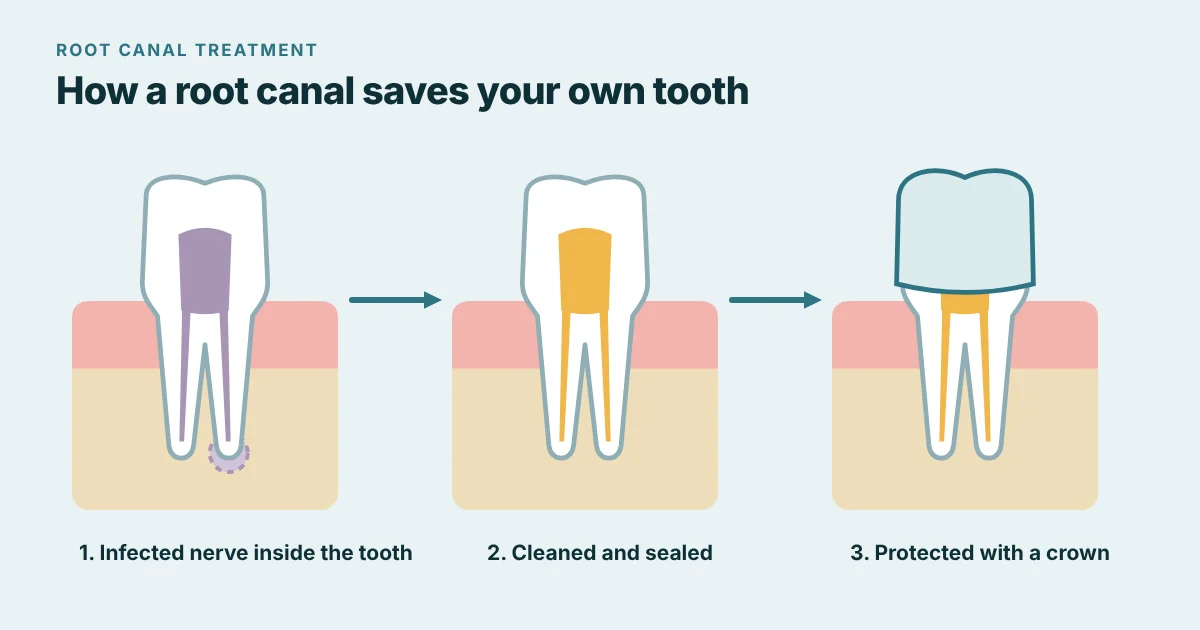
Extraction removes the whole tooth. The pain and infection go away, but you now have a gap, which usually needs to be filled with an implant, a bridge or a denture.
"Can't I just take antibiotics?"
Many people try a course of antibiotics or painkillers from the chemist first. They can calm the swelling for a few days, but they cannot reach the infection inside the tooth, so it comes back, often worse. Antibiotics are sometimes needed alongside treatment, but they are not a treatment on their own. Please don't take antibiotics without a prescription.
When a tooth can usually be saved
Root canal treatment is usually possible when:
- enough healthy tooth is left above the gum to support a filling or crown (if a lot is broken, a post and core can rebuild it first)
- the tooth is not split down into the root
- the gum and bone around the tooth are reasonably healthy, so the tooth is not loose
- the canals can be reached and cleaned
Pain, swelling or an abscess on their own do not mean the tooth must come out. Many badly infected teeth are saved with a root canal.
When extraction is usually the better choice
Extraction is usually advised when:
- the tooth is cracked vertically into the root
- so much of the tooth is destroyed that it cannot be restored, even with a post and crown
- advanced gum disease has destroyed the bone and the tooth is very loose
- it is a wisdom tooth that is not needed for chewing and keeps getting infected
- a previous root canal has failed and re-treatment is unlikely to work
Comparing the two
| Root canal + crown | Extraction | |
|---|---|---|
| Keeps your natural tooth | Yes | No |
| Visits | 1 to 3 for the root canal (often one sitting), then the crown | Usually 1, plus a check |
| Comfort during treatment | Done under local anaesthesia; most people feel pressure, not pain | Done under local anaesthesia |
| Cost today | Higher | Lower |
| Cost over time | Usually lower than extraction plus an implant or bridge | Often higher once the gap is filled |
| Chewing afterwards | Like a natural tooth once crowned | Reduced until the gap is filled |
What happens if a gap is left
It can be tempting to take the tooth out and leave the space, especially if it is at the back. Over months and years, though, a gap can cause:
- the neighbouring teeth to tilt into the space
- the opposite tooth to grow down into the gap
- food to trap between the shifted teeth, leading to decay and gum problems
- harder chewing on that side, and more load on the remaining teeth
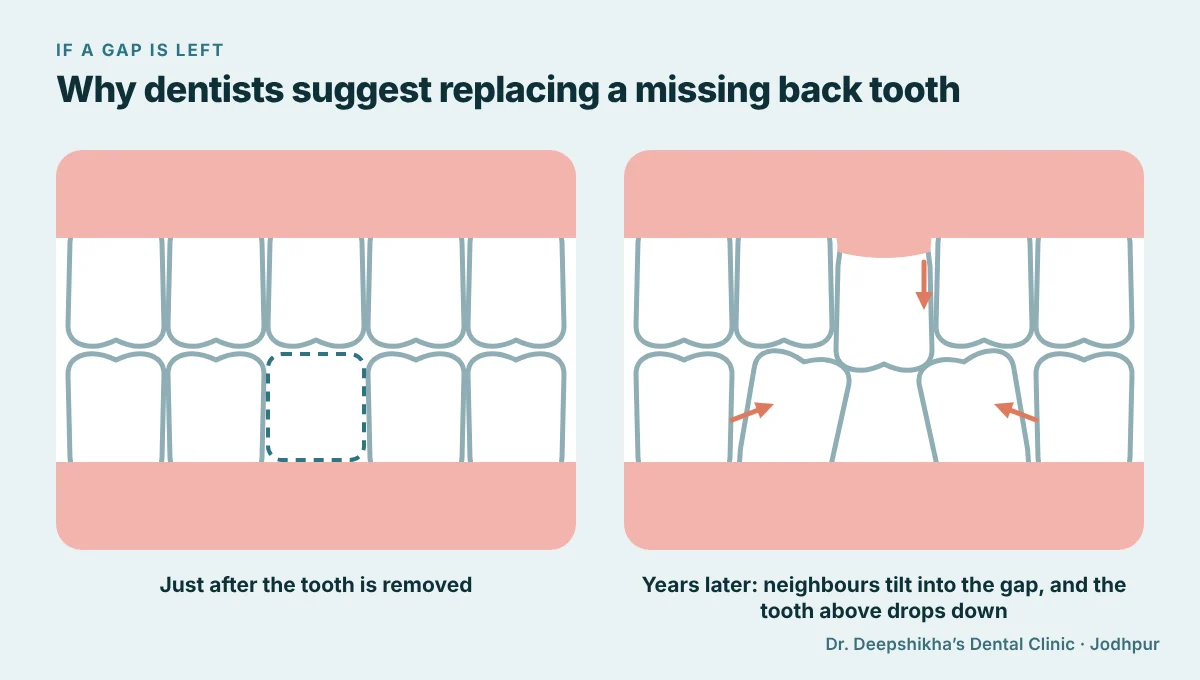
This is why most dentists recommend replacing a lost back tooth, which adds to the true cost of extraction.
Does a root canal hurt?
Root canal treatment is done with local anaesthesia, so the area is numb. Most patients feel pressure and vibration rather than pain. The severe toothache usually comes from the infection, and treatment relieves it. Mild soreness for a day or two afterwards is normal.
Don't delay the crown
This is the most common mistake we see. After a root canal on a back tooth, the tooth is sealed with a temporary filling, the pain goes, and the crown gets postponed for months. In that time the temporary filling can leak, or the weakened tooth can crack while chewing, and a tooth that was saved has to come out after all. Get the crown done within a few weeks, or as your dentist advises.
How long does a root-canal-treated tooth last?
A well-done root canal, protected with a crown where needed and looked after with normal brushing and check-ups, can last for many years. How long it lasts depends mostly on how much healthy tooth was left, how well the tooth is sealed afterwards, and whether you grind or clench. Back teeth usually need a crown, because a treated tooth becomes more brittle and can crack without one.
What about milk teeth?
Badly decayed milk teeth can be treated too, with a simpler version of a root canal called a pulpectomy, followed by a cap. Saving a milk tooth until it is ready to fall out keeps space for the adult tooth underneath. Our guide to your child's first dental visit explains why milk teeth matter.
Questions to ask your dentist
- Can this tooth be saved? What would make it fail?
- Will it need a crown afterwards, and what will the full treatment cost?
- If we take it out, what will we replace it with, and what will that cost?
- How many visits will each option take?
When not to wait
Whichever you choose, do not leave an infected tooth untreated. See a dentist the same day if you have swelling in the face or gum, fever, or pain that keeps you awake. If swelling spreads towards the eye or neck, or you have difficulty swallowing or breathing, go to a hospital emergency department straight away.
Sources: NHS: Root canal treatment, American Association of Endodontists: Root canal explained
This article is general information to help you understand your options. It is not a diagnosis. Every mouth is different, so please see a dentist for advice about your own teeth.