
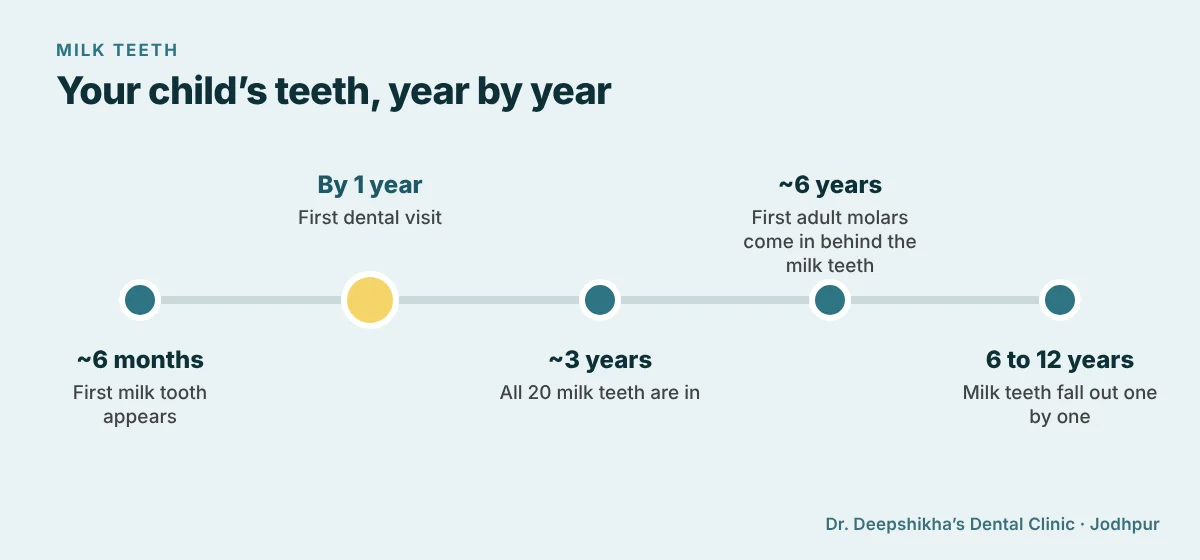
Short answer: take your child for a first dental visit when the first tooth comes through, or by the first birthday at the latest. This is what children's dental associations, including the American Academy of Pediatric Dentistry, recommend. The first visit is short and gentle. Usually there is no treatment at all, just a look, a chat with you and tips for brushing at home.
In most Indian homes the first visit happens much later, often at age 5 or 6, when a child already has a toothache or a black hole in a tooth. By then, treatment is harder for the child and for you.
"They're only doodh ke daant. Why bother?"
This is the question parents ask most. Milk teeth do fall out, but the back ones stay until the age of 10 to 12. Until then they do real work:
- they let your child chew properly, which matters for nutrition
- they help with clear speech
- they hold space for the adult teeth and guide them into place
A milk tooth with a deep cavity can become infected and painful, just like an adult tooth. If it is lost too early, the teeth beside it can drift and the adult tooth may come in crooked.
When should the first visit be?
| Age | What to do |
|---|---|
| First tooth, or by 1 year | First check-up. Learn how to clean the teeth and what to avoid |
| 1 to 6 years | Check-ups as your dentist advises, usually every 6 months. Ask about fluoride varnish |
| Around 6 years | When the first adult molars come in, ask about sealants to protect their grooves |
| Any age | Go the same week for pain, swelling, a broken tooth or black spots |
Fluoride varnish is a quick, painless coating painted on the teeth to make them stronger against decay. Sealants are thin coatings that fill the deep grooves of the back teeth, where food gets stuck most.
What happens at the first visit
For a baby or toddler, the dentist usually examines the teeth with your child sitting on your lap. It takes a few minutes. The dentist will:
- look at the teeth, gums and the way the jaws are growing
- check for early signs of decay, often chalky white lines near the gums
- ask about feeding, night bottles, sweets and thumb-sucking
- show you how to brush your child's teeth and how much toothpaste to use
- tell you when to come back
No drilling, no injections. The aim is for your child to leave thinking the dentist is a friendly place.

How to prepare your child
- Book a morning slot, when your child is fresh and not hungry or sleepy.
- Talk about it simply: "The doctor will count your teeth."
- Avoid words like injection, pain or "it won't hurt". They plant the idea of pain.
- Never use the dentist as a threat ("If you eat chocolate, the doctor will give you an injection"). Many adults who fear the dentist heard this as children.
- Bring a favourite toy, and stay calm yourself. Children copy your mood.
Habits that cause cavities in Indian children
Early childhood tooth decay is very common. The usual causes are everyday habits:
- Milk or juice bottle at night. The milk sits on the teeth for hours. Put only water in a bedtime bottle, and avoid putting your child to sleep while feeding.
- Honey or sugar on a pacifier, or sweet ghutti.
- Frequent sweets, biscuits and toffees through the day, especially as rewards. How often matters more than how much.
- Sharing spoons or pre-chewing food, which passes on cavity-causing bacteria.
- Not brushing at night, or letting a young child brush alone.
How to brush your child's teeth
- Before the first tooth: wipe the gums with a clean soft cloth after feeds.
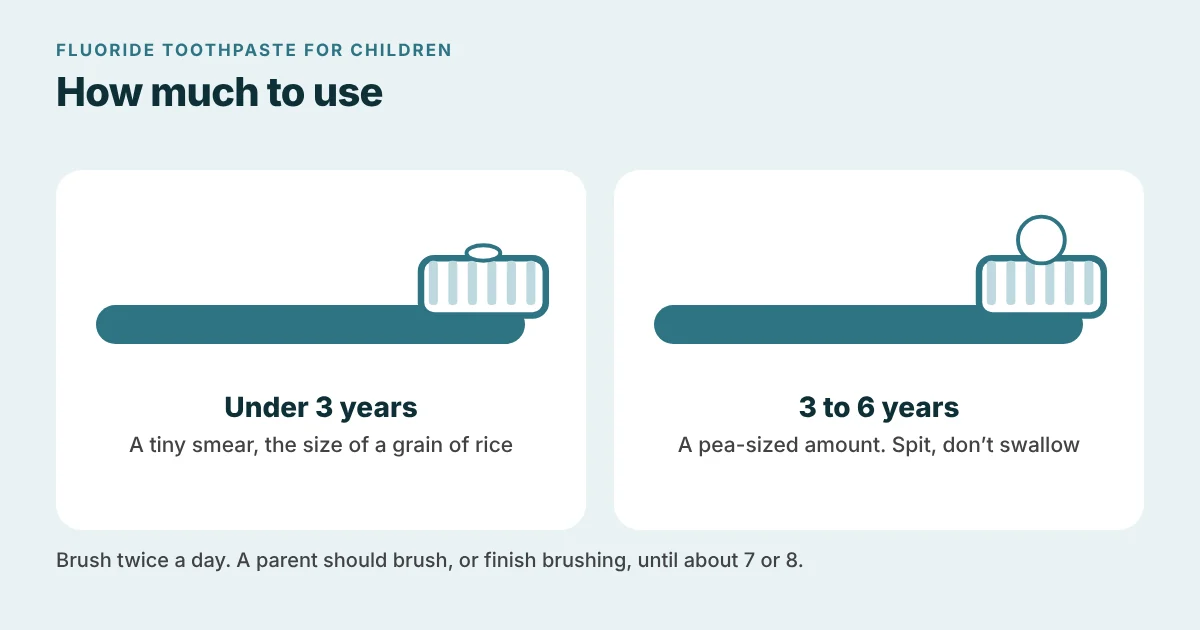
- From the first tooth to age 3: brush twice a day with a tiny smear of fluoride toothpaste, the size of a grain of rice.
- From 3 to 6 years: use a pea-sized amount. Teach your child to spit, not swallow.
- Until about 7 or 8: an adult should brush, or at least finish the brushing. Children don't have the hand control to clean properly before that.
If your family drinks borewell or hand-pump water, read our article on fluoride in Rajasthan's water too.
Two common worries
Teething. Mild irritability, drooling and wanting to chew things are normal when teeth are coming through. High fever, loose motions or a child who is clearly unwell are not caused by teething, so please see your paediatrician rather than putting it down to "daant nikal rahe hain".
Thumb-sucking. It is normal in babies and toddlers, and most children stop on their own. If it continues beyond about 4 years, mention it at the check-up, as it can start to push the teeth and jaws out of shape.
When to see a dentist sooner
- Same day: toothache that keeps your child awake, swelling of the face or gum, a knocked-out or broken tooth after a fall.
- Within a week: black or brown spots, holes in the teeth, chalky white lines near the gums, or pain while eating sweets.
- Routine: if your child is over one year old and has never had a dental check-up.
If a tooth is knocked out: a milk tooth is not put back, but your child should still be seen to check the area. An adult tooth (usually from about age 6 onwards) can often be saved: hold it by the white top, not the root, rinse it gently if dirty, and put it back in the socket or keep it in milk, and come in straight away. The first hour matters.
Our children's dentistry page explains how we keep visits short and calm, and our guide to tooth pain and cavities in children covers what to do if your child already has a problem.
If you'd like to bring your child in for a first check-up in Jodhpur, you can book on WhatsApp.
Sources: American Academy of Pediatric Dentistry: Parent FAQ, NHS: Children's teeth
This article is general information to help you understand your options. It is not a diagnosis. Every mouth is different, so please see a dentist for advice about your own teeth.