
Short answer: choose a dentist who is registered with the State Dental Council, sterilises instruments properly, explains your problem and every option before starting, tells you the full cost up front, and takes an X-ray when one is needed. Convenience matters too, because the best dentist is the one you will actually go back to for check-ups.
Searching "best dentist in Jodhpur" gives you a long list of names, star ratings and offers. But the right dentist for you is not simply the one with the biggest advertisement. It is the one who is properly qualified, keeps instruments safe, explains your options honestly and treats you without hurry.

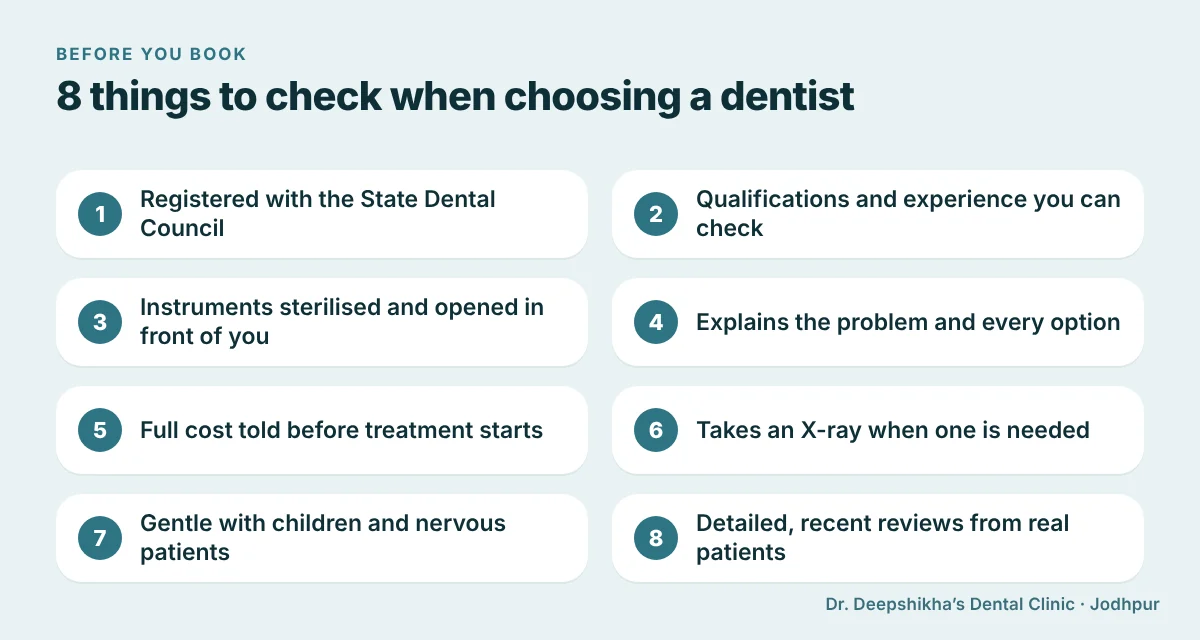
Here are eight questions worth asking, whether you are choosing a dentist for yourself, your children or your parents.
1. Is the dentist registered?
Every practising dentist in India must hold a B.D.S. degree and be registered with the State Dental Council (in Rajasthan, the Rajasthan Dental Council). Registration means the degree has been verified and the dentist is accountable to a professional body.
You can simply ask for the registration number. A genuine dentist will not mind; many display it at the clinic.
2. What are the dentist's qualifications and experience?
B.D.S. (Bachelor of Dental Surgery) is the basic dental degree: four years of study followed by a one-year compulsory internship. M.D.S. (Master of Dental Surgery) is a further three years of postgraduate training in one branch of dentistry, such as:
- Conservative Dentistry and Endodontics (fillings and root canals)
- Prosthodontics (crowns, bridges, dentures and implants)
- Orthodontics (braces and aligners)
- Periodontology (gums)
- Oral and Maxillofacial Surgery (extractions and surgery)
- Paediatric and Preventive Dentistry (children)
Experience matters too. Ask how often the dentist does the treatment you need. For complex work, such as implants or full mouth treatment, it is reasonable to ask whether the dentist does it personally or works with a visiting specialist.
3. How are instruments cleaned and sterilised?
Dental instruments go into the mouth and touch saliva, so sterilisation is not optional. A careful clinic will:
- clean and sterilise instruments in an autoclave (a pressure steriliser)
- keep sterilised instruments in sealed pouches and open them in front of you
- sterilise the drill handpieces between patients, not just wipe them
- use a new needle, new gloves and a fresh mask for every patient
- cover or disinfect the chair and surfaces between patients
If you cannot see this, ask. A good clinic is happy to show you.
4. Will the dentist explain the problem and the options?
You should leave the first visit understanding three things: what is wrong, what the choices are (including what happens if you wait), and why the dentist recommends one option.
Be cautious if you are pushed towards an expensive treatment on the first visit without an explanation, an X-ray or time to think. Apart from emergencies, most dental treatment can wait a day while you decide. Be careful, too, of promises that sound too good, such as a "guaranteed painless" treatment or a whole smile makeover in one sitting.
5. Are costs explained before treatment starts?
Ask for the cost of the full treatment, not just the first sitting. For example, a root canal on a back tooth usually needs a crown afterwards, and an implant has several stages. A clear estimate up front avoids surprises later.
The cheapest option is not always the best value. A well-made crown that lasts many years often costs less in the long run than a cheap one that needs replacing. If you are weighing up a root canal against taking the tooth out, our article on root canal or extraction compares the true cost of each.
6. Does the dentist take an X-ray when needed?
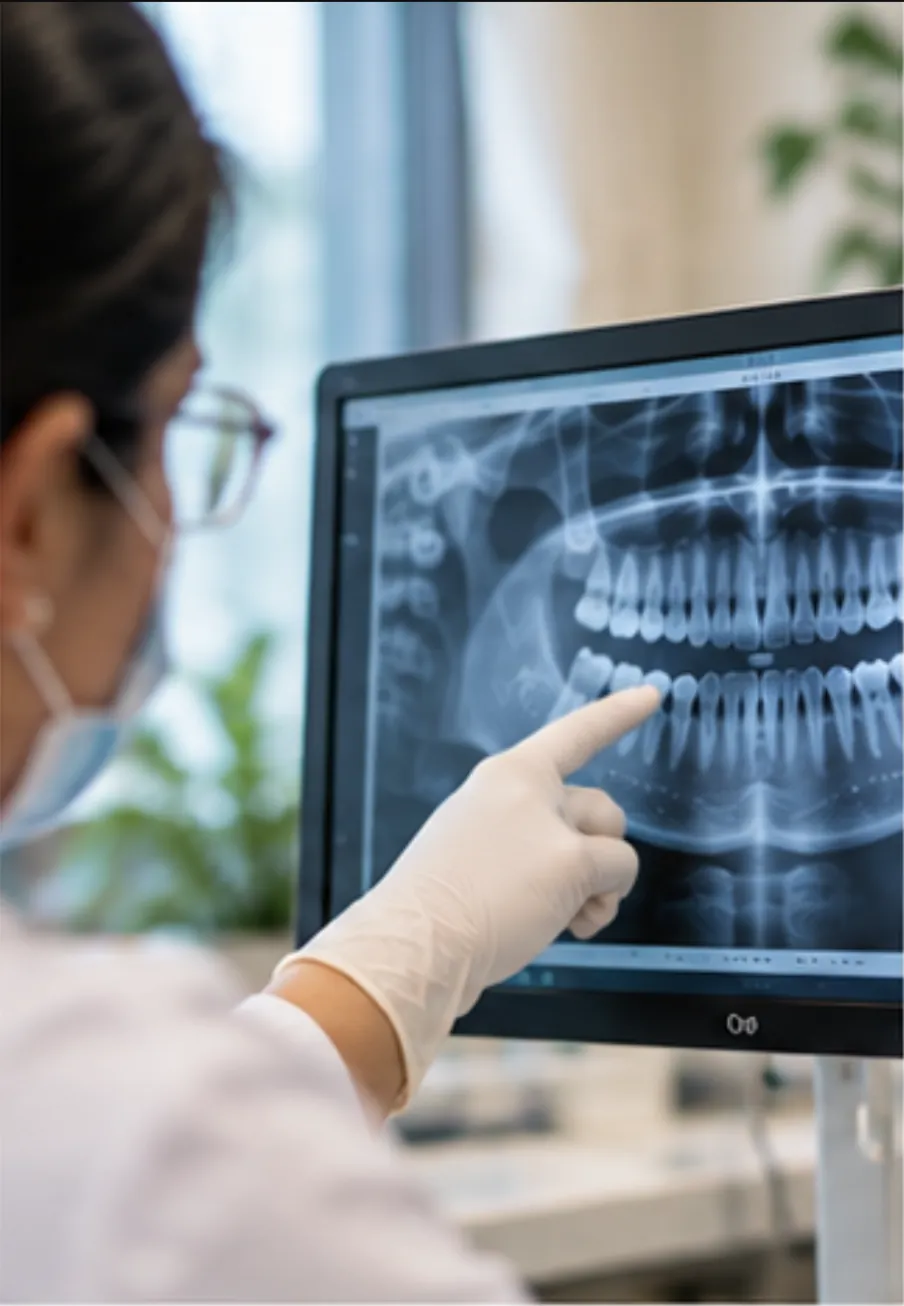
Many problems, such as decay between teeth, infection at the root or an impacted wisdom tooth, cannot be seen by eye. For root canals, extractions and implants, an X-ray before treatment is standard practice. Most clinics now use a small digital X-ray of one or two teeth (often called an RVG), and a full-mouth X-ray (OPG) when the whole jaw needs to be seen. Digital X-rays use a very small dose of radiation.
7. How are children, nervous patients and emergencies handled?
If you are choosing a family dentist, ask:
- Are children seen, and how is a first visit made comfortable for them? Our guide to your child's first dental visit explains what a good first visit looks like.
- What happens if you are nervous? Is the dentist willing to go slowly and stop when you raise a hand?
- If you have severe pain or swelling, can you be seen the same day? What should you do after clinic hours?
- If you have diabetes, heart disease, take blood thinners or are pregnant, does the dentist ask about it before treatment?
8. What do other patients say?
Google reviews are useful when you read them properly. Look for:
- Recent reviews, not only old ones
- Reviews that mention a specific treatment, such as a root canal or a child's filling
- How the clinic replies, especially to a complaint
A few detailed, genuine reviews tell you more than a large number of one-line ones.
Practical things that make regular visits easier
Dental health depends on regular check-ups, so convenience matters. Consider the distance from home or work, opening hours (including weekends), whether you can book on WhatsApp or by phone, and whether the dentist speaks the language you are most comfortable in, whether that is Hindi, Marwari or English.
Choosing a dentist for your family
The right dentist is one you can return to for years: someone who knows your history, catches small problems early and explains things honestly. If you are looking for a dentist in Jodhpur, we are happy to answer any of these questions before you book.
Sources: Dental Council of India, NHS: X-rays
This article is general information to help you understand your options. It is not a diagnosis. Every mouth is different, so please see a dentist for advice about your own teeth.