
Short answer: if you chew gutkha, khaini, zarda, paan with tobacco or supari, or you smoke, get your mouth checked by a dentist at least once a year. See a dentist or doctor straight away if you notice an ulcer that has not healed in 3 weeks, a white or red patch, a lump, or difficulty opening your mouth. Found early, mouth cancer is much easier to treat.
Why this matters so much in India
Mouth cancer is one of the most common cancers in Indian men. An analysis of the global cancer figures for 2022 estimated about 1.4 lakh new cases of oral cancer in India that year, and around 80,000 deaths. A large share of these are linked to chewing tobacco and areca nut, which means many of them can be prevented, and many more can be caught early.
Why chewing tobacco and supari are so harmful
The World Health Organization lists tobacco, alcohol and areca nut (supari, betel quid) among the leading causes of oral cancer. When gutkha or khaini is kept in the same spot inside the cheek for long periods, the lining of the mouth is exposed to harmful chemicals again and again. Areca nut alone, even without tobacco, damages the mouth over time. "Sweet supari" and paan masala without tobacco are not safe either.
Smoking beedis or cigarettes, and drinking alcohol regularly, add to the risk. The risk is highest in people who use more than one.
Early warning signs
Most early changes do not hurt, which is why people ignore them. Look in a mirror with good light once a month, especially at the place where you keep the tobacco.
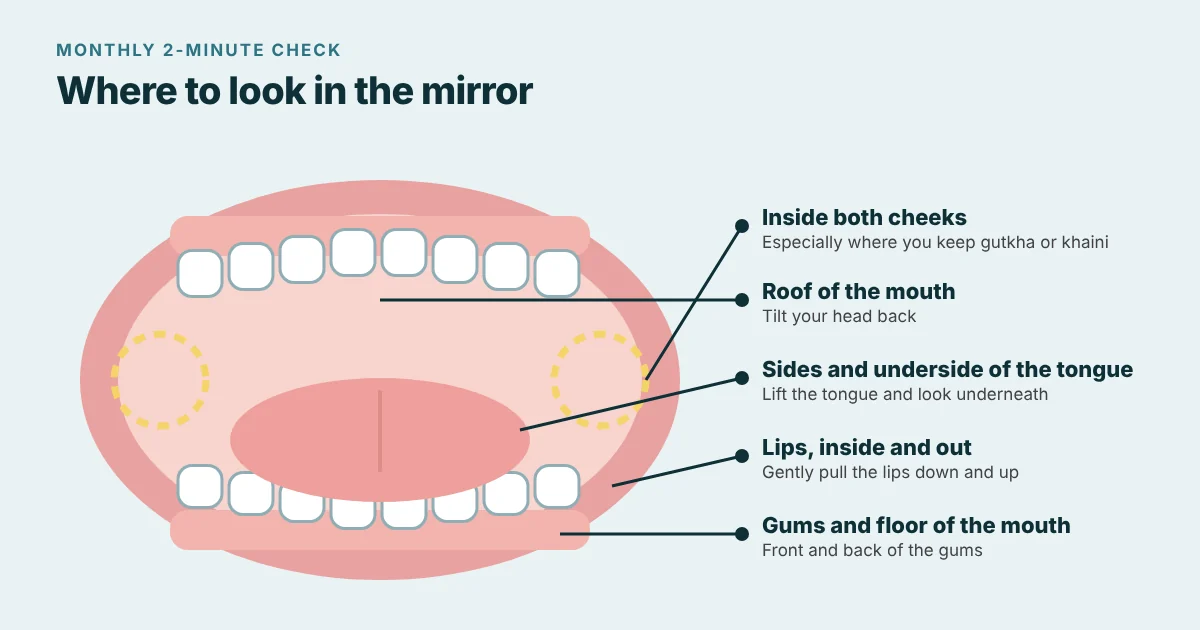
Get checked if you notice:
- a mouth ulcer that has not healed in 3 weeks
- a white patch that does not rub off
- a red patch, or a red and white speckled patch
- a lump or thickening in the cheek, tongue, gums or lip
- difficulty opening your mouth fully, or cheeks that feel stiff and leathery
- a burning feeling when eating spicy food that wasn't there before
- pain in the mouth that does not go away
- difficulty swallowing, or a hoarse voice that lasts
- a lump in the neck
- losing weight without trying
Having one of these does not mean you have cancer. Many have simpler causes, such as a sharp tooth rubbing the cheek or a denture that does not fit. But they need to be checked rather than watched.
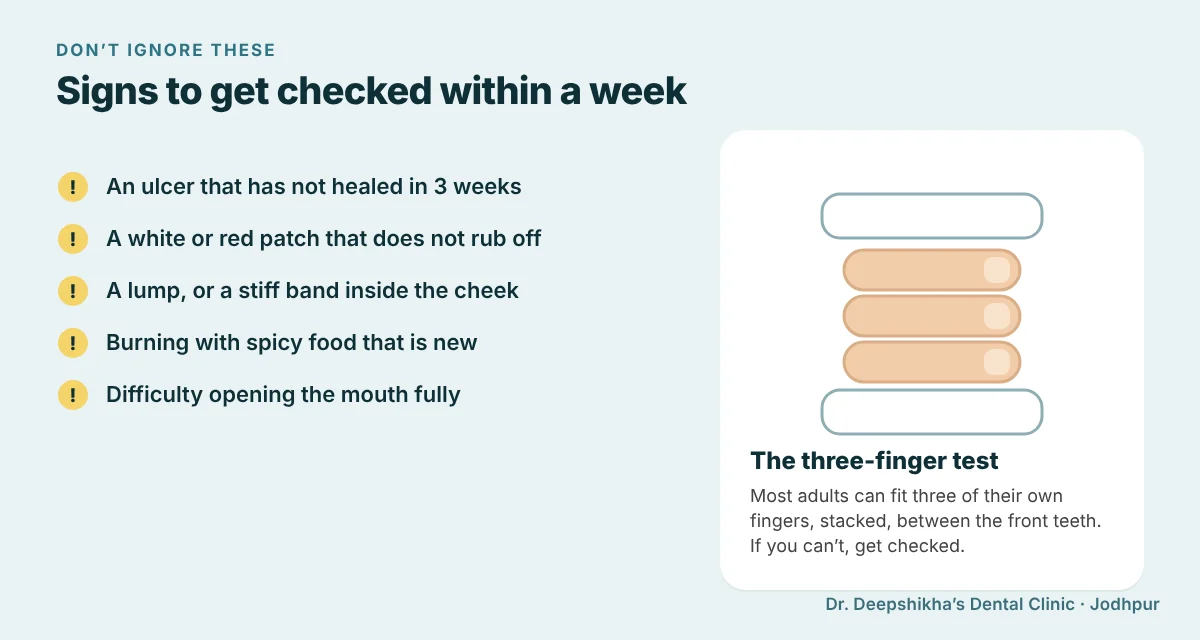
The three-finger test
A simple check for stiffness: open your mouth as wide as you comfortably can and try to fit three of your own fingers, stacked on top of each other, between your upper and lower front teeth. Most adults can. If you can only fit two, or your cheeks feel tight like a band, it can be an early sign of oral submucous fibrosis, and it is worth getting checked.
Changes that can come before cancer
Some changes are called "potentially malignant", meaning they can turn into cancer over time if the habit continues:
| Change | What you might notice |
|---|---|
| Leukoplakia | A white patch that does not wipe off |
| Erythroplakia | A red, velvety patch; less common but more serious |
| Oral submucous fibrosis | Stiff, pale cheeks, burning with spicy food and a mouth that will not open fully; strongly linked to chewing areca nut and gutkha |
Stopping the habit early can help these changes stop getting worse, and some may improve. Your dentist can monitor them and refer you for a biopsy when needed.
What happens at a mouth check
A mouth cancer check takes a few minutes and does not hurt. The dentist:
- asks about your habits, honestly and without judging
- looks at the whole mouth: cheeks, tongue (including underneath), gums, palate and lips
- feels the cheeks, floor of the mouth and the neck for lumps
- notes any patch or ulcer and its size, and may take a photo to compare later
- refers you to an oral surgeon or cancer specialist for a biopsy if anything looks suspicious
A biopsy means taking a very small piece of the patch to examine under a microscope. It is done with local anaesthetic and is the only way to know for certain what a patch is.
Stopping the habit
Stopping is the single most important thing you can do for your mouth, at any age. If you have tried and found it hard, you are not alone. Speak to your doctor about nicotine replacement or other support, or call India's free National Tobacco Quitline on 1800-11-2356. Tell your dentist too: regular check-ups while you quit help catch any changes early.
Worth knowing: many people stop gutkha only after a patch appears. Some early white patches fade once the habit stops, which is one more reason to quit now and get any patch checked, rather than wait to see what happens.
When to see a dentist
- Within a week: any white or red patch, lump, or difficulty opening your mouth.
- If an ulcer has lasted 3 weeks: don't wait for it to heal on its own.
- Once a year at least: a routine check if you use, or have used, any form of tobacco or supari.
Sources: NHS: Mouth cancer symptoms, NHS: Mouth cancer causes, WHO: Oral health fact sheet, ecancermedicalscience: Oral cancer burden in India, GLOBOCAN 2022 analysis, Ministry of Health, Govt. of India: National Tobacco Quit Line Services
This article is general information to help you understand your options. It is not a diagnosis. Every mouth is different, so please see a dentist for advice about your own teeth.