
Short answer: white streaks, yellow-brown patches or tiny pits that have been on the teeth since childhood are often dental fluorosis. It happens when a child takes in too much fluoride, usually from drinking water, while the adult teeth are still forming. It is not decay and it does not spread, and most cases can be made much less noticeable if the look bothers you.
Why it is common in Rajasthan
Fluoride occurs naturally in groundwater. A little fluoride protects teeth, which is why it is in toothpaste. Too much, taken while teeth are forming, damages the enamel.
The Bureau of Indian Standards sets 1.0 mg per litre as the acceptable level of fluoride in drinking water, and 1.5 mg per litre as the maximum where no other source is available. Groundwater in many parts of Rajasthan, especially from borewells and hand pumps in villages, has been found above these limits. People who grew up drinking such water often have fluorosis, even if they now live in a city with treated water.
Who gets it
Dental fluorosis forms only while the teeth are developing, roughly up to the age of 8. After that, the enamel of the permanent teeth is complete. So:
- An adult cannot develop new fluorosis, even from high-fluoride water.
- Stains that appear in adulthood usually have a different cause, such as tea, tobacco or tartar.
- Children under 8 are the ones to protect.
What it looks like
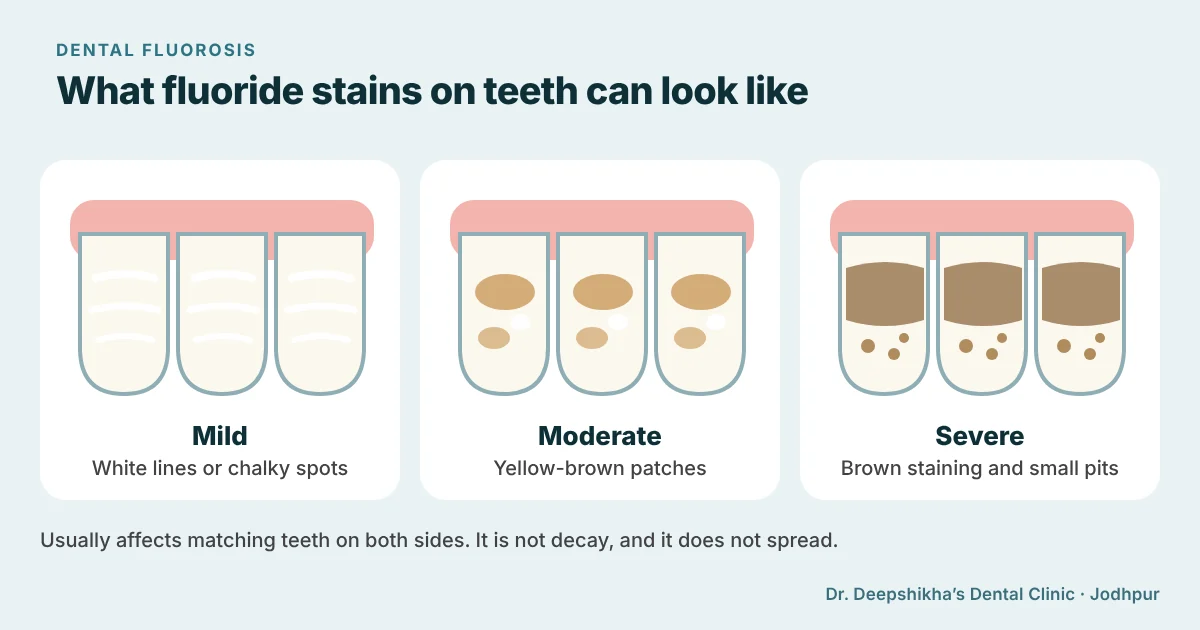
| Severity | How the teeth look |
|---|---|
| Very mild to mild | Faint white lines or chalky white spots, often on the front teeth |
| Moderate | Larger white areas with yellow or brown patches |
| Severe | Brown-black staining, pitting and rough, weak enamel that can chip |
Dentists grade fluorosis on a standard scale (Dean's index), from questionable and very mild up to severe, which helps plan the right treatment.
Fluorosis usually affects several teeth in a matching pattern on both sides of the mouth. Stains from tea or tobacco look different: they sit on the surface, mostly near the gums and between teeth, and a cleaning removes much of them. Our article on teeth cleaning myths explains what a cleaning can and can't remove.
Is it harmful?
Mild fluorosis is a cosmetic problem only: the teeth work normally and do not hurt. Severe fluorosis can make enamel weak and pitted, so those teeth can chip or wear faster and need protection.
Very high fluoride over many years can also affect bones and joints (skeletal fluorosis). If your family still drinks from a high-fluoride source, it is worth getting the water tested.
How it is treated
Treatment depends on how deep the stain is. Your dentist will usually start with the simplest option:
- Professional cleaning and polishing, to remove surface stains sitting on top of the fluorosis.
- Micro-abrasion, which gently removes a very thin layer of stained enamel. It works well for shallow white or brown marks.
- Resin infiltration, where a thin, clear resin soaks into chalky white spots so they blend in, without drilling.
- Teeth whitening, which can blend white patches with the rest of the tooth. It is often combined with micro-abrasion.
- Tooth-coloured bonding, where composite material covers deeper stains or pits, usually in one visit.
- Veneers or crowns for severe fluorosis, where the enamel is badly pitted or the teeth are weak.
Whitening on its own can sometimes make white fluorosis spots look brighter, so it is best planned after an examination.
Protecting children
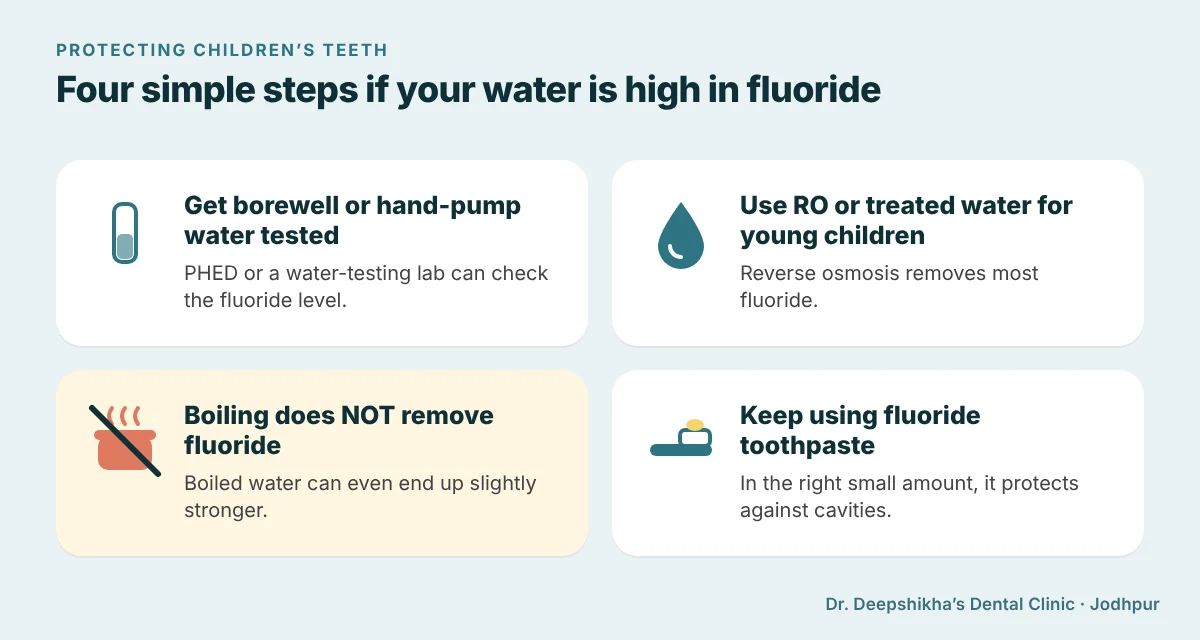
- If your water comes from a borewell or hand pump, get it tested for fluoride. The local Public Health Engineering Department (PHED) or a water-testing laboratory can do this.
- If the level is high, use RO or treated water for drinking and cooking for young children. Reverse osmosis removes most fluoride.
- Boiling does not remove fluoride. As some water evaporates, the fluoride in what's left can even become a little stronger.
- Use a rice-grain smear of fluoride toothpaste for children under 3, and a pea-sized amount from 3 to 6, and teach them to spit, not swallow.
- Don't stop using fluoride toothpaste altogether. The small amount in toothpaste protects against cavities; the problem is excess fluoride swallowed every day from water.
Worth knowing: fluorosis marks are permanent, but they are not a sign of weak or dirty teeth, and they don't spread. Many people carry these stains for years thinking nothing can be done. Today, most cases can be made far less noticeable in one or two visits.
When to see a dentist
Book a check-up if the stains bother you, if the enamel feels rough or chips, or if a child's new adult teeth come through with white or brown marks. Bring a note of where the family's drinking water comes from; it helps the dentist understand the cause.
Sources: CDC: About dental fluorosis, WHO: Oral health fact sheet
This article is general information to help you understand your options. It is not a diagnosis. Every mouth is different, so please see a dentist for advice about your own teeth.