
Short answer: both braces and clear aligners can straighten teeth in adults. Aligners are almost invisible and come out for meals, but they only work if you wear them about 22 hours a day. Braces stay on all the time, so they work without daily discipline, and they handle complex cases better. Your dentist can tell you which suits your teeth after an examination, X-rays and a scan or impressions.
Am I too old for braces?
No. Teeth can be moved at any age as long as the gums and bone around them are healthy. Many adults in India straighten their teeth in their 20s, 30s and 40s, often before a wedding, a new job, or simply because they finally can.
Adults do need one extra step first: a check of the gums. Moving teeth in gums that bleed or have lost bone can make things worse, so gum problems are treated, and the teeth cleaned, before any braces or aligners go on.
What's the difference?
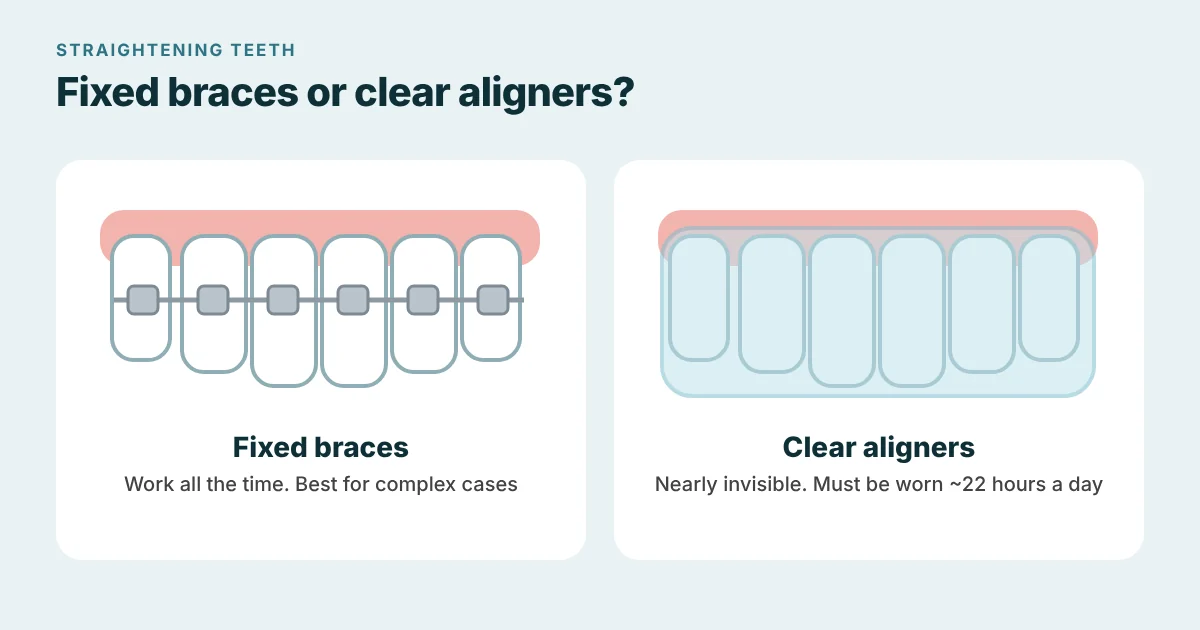
Fixed braces are small brackets stuck to the teeth and joined by a wire. The wire is adjusted every few weeks. Metal braces are the most common; ceramic braces use tooth-coloured brackets that are much less noticeable, and lingual braces are fixed behind the teeth so they can't be seen from the front.
Clear aligners are a series of thin, transparent plastic trays made from a scan of your teeth. You change to a new set every week or two, and each set moves the teeth a little.
Braces vs aligners at a glance
| Fixed braces | Clear aligners | |
|---|---|---|
| How they look | Visible (metal) or less visible (ceramic) | Nearly invisible |
| Wear time | On all the time; nothing to remember | About 22 hours a day, taken out only to eat and brush |
| Eating | Avoid hard and sticky food (bhutta, hard nuts, chikki, toffees) | Take them out and eat anything; brush before putting them back |
| Cleaning | Harder; food traps around brackets | Easy; brush and floss normally |
| Comfort | Brackets can rub the cheeks at first | Smooth; pressure for a day or two with each new set |
| Complex cases | Handles most cases, including severe crowding and bite problems | Many cases, but some complex ones still need braces |
| Check-ups | Every 4 to 6 weeks for adjustment | Usually every 6 to 10 weeks |
| Discipline needed | Low | High. Forgetting to wear them slows or stops progress |
Who suits aligners better?
Aligners usually suit adults who:
- have mild to moderate crowding or gaps
- can genuinely keep them in for about 22 hours a day, including while sleeping
- want treatment that is hard to notice at work or in photos
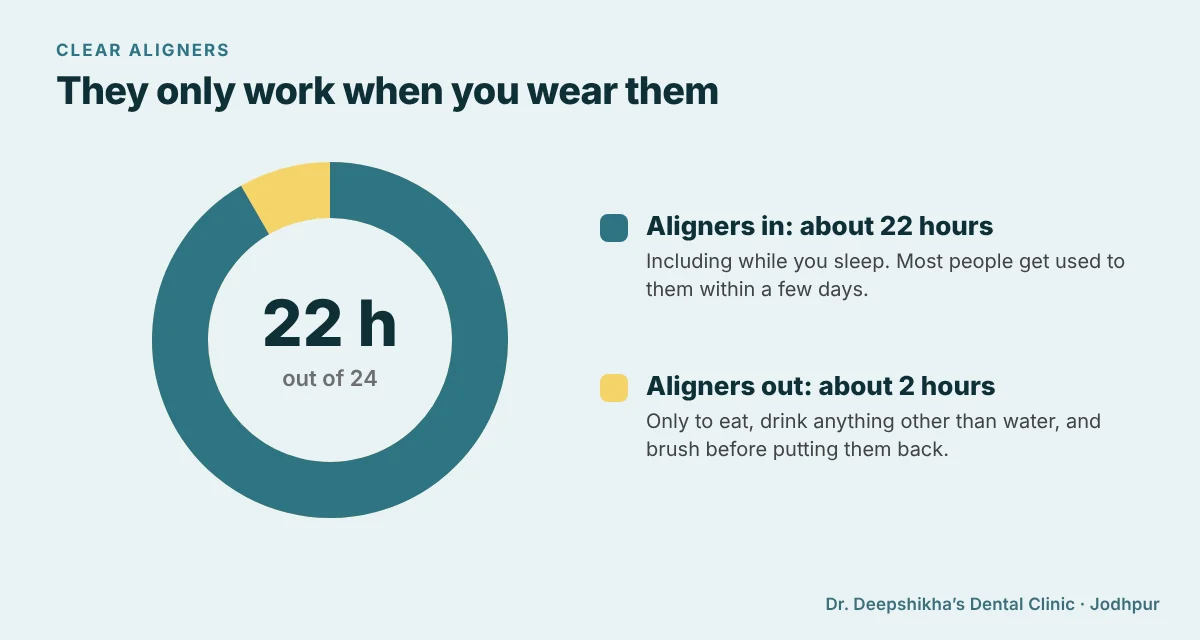
Things to be honest with yourself about: if you snack or drink sweet chai through the day, you will need to take the aligners out and brush every time. If that won't happen, aligners can trap sugar against the teeth and cause decay.
Who suits braces better?
Braces are often the better choice for:
- severe crowding, large gaps, or teeth that need to rotate a lot
- bite problems where the jaws don't meet properly
- people who know they will forget or remove a removable appliance
What to expect when you start
- Planning comes first. Expect photos, a scan or impressions, and X-rays, usually a full-mouth X-ray (OPG) and a side view of the skull and jaws (cephalogram). These show the roots and how the jaws meet.
- "Will teeth need to be removed?" Sometimes, yes. When there isn't enough room, one or two teeth (often premolars) may be taken out to make space. Your dentist will explain why if this is needed.
- The first few days are sore. Teeth ache when they start to move, and new braces can rub the cheeks. Soft food and orthodontic wax over the brackets help; the soreness usually settles within a week.
How long does treatment take?
It depends on the case, not the method. Simple cases can finish in under a year; most full treatments take about 12 to 24 months. Aligners are often about as quick as braces for straightforward cases. Your dentist can give you an estimate after planning.
A word about "order online" aligners
Aligners sold with little or no in-person examination are tempting because they look cheaper. But moving teeth without checking the gums, roots and bite first can cause problems that are expensive to fix. Whatever you choose, make sure a dentist examines you, takes X-rays and checks your progress in person.
What happens after: retainers
Every straightening treatment ends with a retainer. Teeth tend to drift back, especially in the first months. Most people wear a retainer at night for the long term, and some have a thin wire fixed behind the front teeth. Skipping the retainer is the most common reason teeth go crooked again.
Questions to ask before you start
- Do my gums need treatment first?
- Can my case be done fully with aligners, or might I need braces later?
- Will any teeth need to be removed?
- How long will it take, and how often will I need to visit?
- What is included in the cost: refinements, extra aligners, retainers?
- Who plans the treatment, and who will I see at check-ups?
When to see a dentist
- Routine: if crooked or gapped teeth bother you, make it hard to clean, or your bite feels uneven.
- Sooner: if teeth are becoming more crowded, a gap is widening, or teeth feel loose. These can be signs of gum disease and need checking first. Our article on diabetes and gum disease shows the warning signs.
Our page on braces and aligners explains how treatment works at the clinic, and crooked teeth and gaps covers other options, such as bonding for small gaps.
If you're weighing up braces or aligners in Jodhpur, you're welcome to ask us on WhatsApp.
Sources: Penn Dental Medicine: Why patients should consider clear aligners, NHS: Braces and retainers
This article is general information to help you understand your options. It is not a diagnosis. Every mouth is different, so please see a dentist for advice about your own teeth.